
Version spine / Current
From citizens to cores
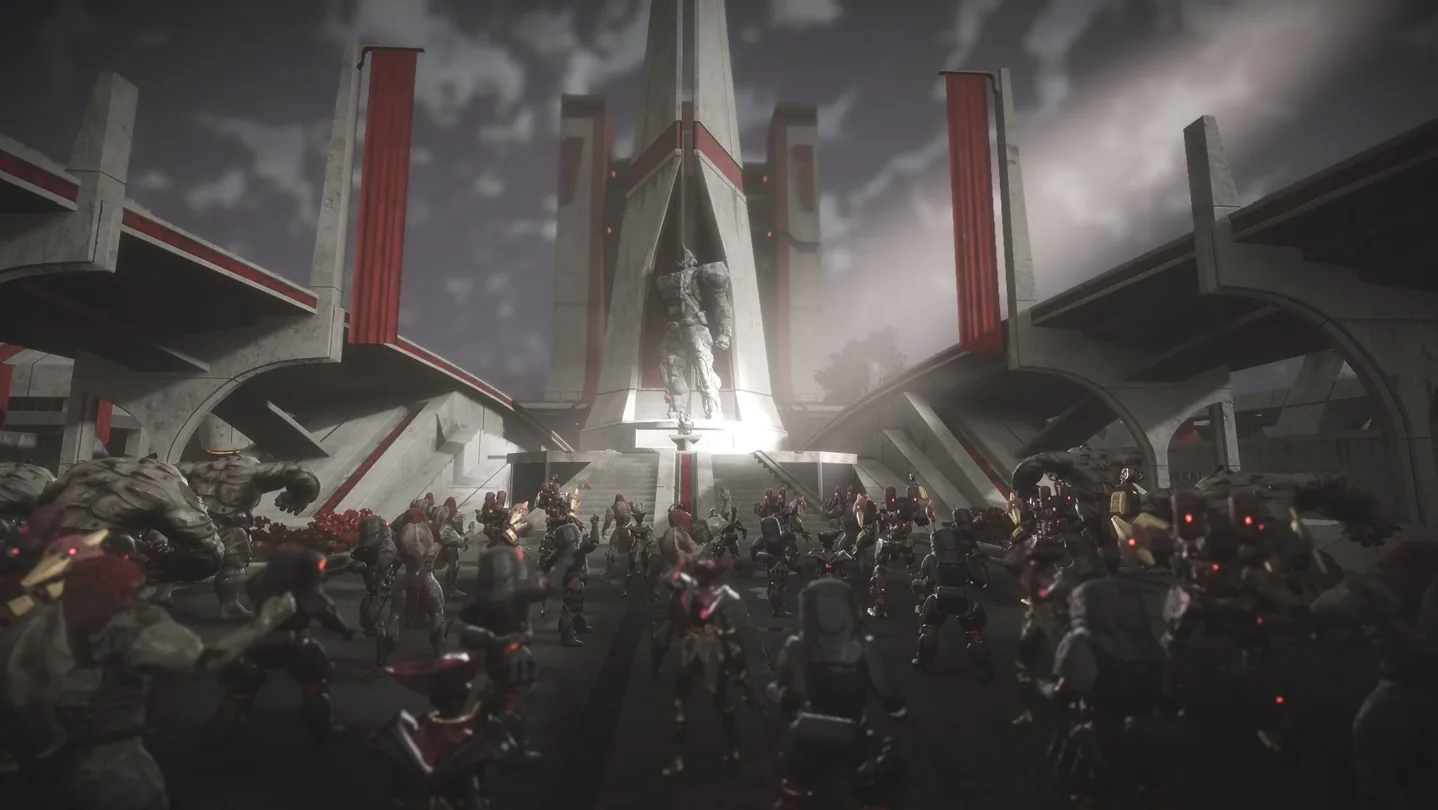
Pax Autocratica is easiest to read as a loop between a controlled colony and the violence required to keep it supplied. The current record describes a darkly satirical colony sim and first-person roguelite hybrid: establish a totalitarian colony, direct citizens, take expeditions into the Tyris System, and lead troops into battles that can grow from infantry engagements into mechanized war. The state is not a menu around the action. It is the pressure that makes every expedition matter.
This overview keeps three timelines visible. The current Early Access build is the main reference for systems pages. The earlier prologue remains a separate historical context, while the full-release marker is a planned boundary rather than a list of promised features. That separation is useful when a store description, a patch note and a player question appear to describe the same game at different moments.
Use the command rail to move from the state overview into colony work or combat cores. Use the records rail for updates, system requirements and the official media set. Each route is deliberately narrow: a player should be able to tell what to manage, what to bring into battle, and which version line a statement belongs to without decoding a general-purpose database.
DIRECTIVE 01 / THE STATE LOOP
Colony to battlefield: the operating loop
The core loop starts with colony foundation rather than with a character sheet. The player establishes a totalitarian colony, then turns that political decision into an operating system for citizens and production. Work is the visible bridge: resources are gathered, supplies are centralized, technology is researched, and manufacturing and farming turn inputs into equipment and food. The result is not a promise of a hidden simulation model; it is the documented chain that makes the colony legible as preparation for the next expedition.
Resource expeditions extend the loop beyond the settlement. The captured store description ties expeditions to gathering resources, conscripting citizens and trading with wandering merchants. These actions give the colony a reason to exist outside its borders. They also create a clean reading rule for the reference: a resource record belongs with colony management, while the moment a troop is led into a first-person battle belongs with combat. The routes meet at the handoff, not in a blended pile of mechanics.
Combat then changes the state rather than ending the loop. Infantry can be led through first-person battles; tanks and mechs express a larger escalation; capture and conversion turns defeated enemies into true believers; and weapon, combination and troop-support cores carry a roguelite layer into the next confrontation. In that shape, the state is both the destination of a successful expedition and the constraint placed on the next one.
DIRECTIVE 02 / CIVIC PRESSURE
Governance is a production input
The civic layer is described through consequences rather than a simple alignment meter. Governance shapes fear, loyalty and gratitude, while citizen bonds and feuds make the colony social as well as industrial. That language matters for a player deciding what to read first: the citizen roster is not only a list of bodies for jobs, and a policy is not only a passive modifier. It is part of the pressure that determines how a settlement can keep moving when resources or troops are scarce.
The reference therefore treats work assignments as a directive ledger. Mining and gathering create the raw flow into the colony. Hauling moves supplies toward a center, research opens technology and options, and manufacturing with farming handles equipment and food. Those records are intentionally plain because the evidence supports the role and output, not a fabricated production formula. A useful decision starts with the documented job, then asks what the next expedition needs from that output.
The same boundary keeps the social reading honest. The current record supports citizens, conscription, bonds and feuds; it does not supply a complete morale equation, a fixed population cap or a universal optimal schedule. Players can use the colony page to understand the relationship between a role, its output and the next battlefield requirement, while keeping unsupported numeric optimization out of the state brief.
RECORD 03 / VERSION SPINE
Current, historical and planned material
The version spine is part of the content, not a footer disclaimer. The current anchor is the Early Access record dated 10 August 2026, with a maintenance context dated 11 August that covers save-data, tutorial, battle-model and stability corrections. The prologue anchor is dated 1 December 2025 and is retained as historical context. A full-release marker exists as a plan boundary only; it is not expanded into an invented roadmap.
This distinction prevents a common reference error. A prologue screenshot can explain the lineage of a feature without proving that the same screen is current. A maintenance notice can establish that a correction was issued without proving every later behavior. A future-facing note can show the direction of a product policy without becoming a feature checklist. Each route carries the version label close to the fact so that a player can use the information without silently merging separate snapshots.
The updates route holds dated records, while this page keeps the interpretive spine visible. When a player asks whether a system belongs to the current build, start with the current marker, then compare the historical record only when it clarifies context. When the question is about what may arrive later, use the planned marker as a boundary and stop at what the captured source actually says.
Current · ea-2026-08-10
Version boundary · Current
ea-2026-08-10Historical · prologue-2025-12-01
Version boundary · Historical
prologue-2025-12-01Planned · full-release-planned
Version boundary · Planned
full-release-plannedFIELD NOTE / READING ORDER
A practical reading order
Begin with Colony and citizens if the immediate task is getting a settlement moving. The page groups the colony image record, the work ledger and the civic layer so that production roles can be read as inputs to a larger loop. Move to Combat and cores when the task turns into a first-person battle, mechanized escalation or core choice. The combat page keeps troop types, capture and conversion, weapon cores and support cores in one connected brief.
Use Updates and versions to check whether a statement belongs to launch, maintenance, the prologue or a planned boundary. Use System requirements before installation, and use Official media when a visual or video source is more useful than prose. The source links on each route lead back to official material in a new tab. This desk is an index into a changing game, not an attempt to make the source disappear behind a confident summary.
The route is bounded to the captured official store and publisher record for the current version line.